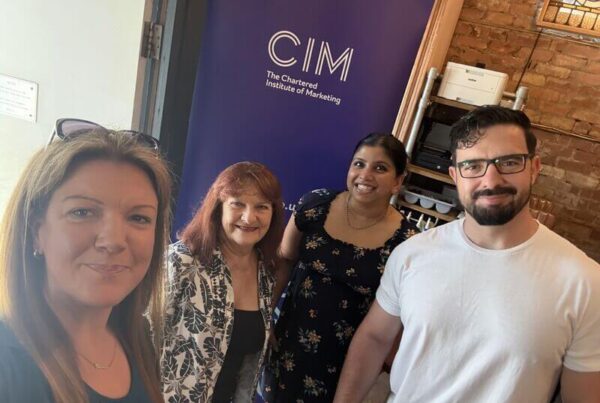


This was my first time at the CIM Digital Marketing Conference. If I were to describe it n a word: extraordinary.
I’ve been meaning to get to this one for years.
And when I finally did, it was at the Imperial War Museum in Duxford, on what turned out to be one of those days where you walk in slightly tired and walk out genuinely buzzing.
That doesn’t happen by accident. It happens when the speakers are good, the room is engaged and the conversation feels relevant to the actual work people are doing. All three were true on Wednesday.
It was also the day I finally met CIM CEO Chris Daly in person.
Here’s how the day went.
Tristan Silva, IAB – where the money is going
Tristan opened with the numbers on digital advertising – and the headline is this: ad spend is projected to reach £49 billion by 2027. That’s not just a big number. It’s a signal about where attention is going, and what marketers need to be planning for. A grounding start that set the context for everything that followed.
Abdul Zahid, Anglia Ruskin University – Me Marketing
Abdul made the case for what he’s calling Me Marketing – the idea that appealing to people as individuals, using emotion rather than logic, is what actually moves them.
This landed for me because it’s something I’ve believed for a long time. People make decisions emotionally. They justify them rationally afterwards. If your marketing isn’t connecting at a human level first, it’s working a lot harder than it needs to.
Margaret Ward, CC’d Consultancy – email as community
This was the session I’ve been thinking about most since Wednesday.
Margaret didn’t just give us theory. She gave us methodology. And her reframe around email was genuinely fresh.
Not email marketing in the way most people think about it – promotions, discount codes, the stuff that fills up inboxes and gets unsubscribed from. Email as a community. Something people actively want to be part of.
Something they’d miss if it stopped arriving.
That’s a completely different brief to write to. And it changes the results.
Luke Brynley-Jones, OST – LinkedIn done properly
Luke walked us through how to get the most from LinkedIn – both pages and personal profiles. Practical. Specific. No padding. Exactly what a room full of B2B marketers needed to hear.
Jo Bird – personal branding
Jo reminded everyone in the room that personal branding isn’t optional anymore. If you’re in marketing and you’re not visible, you’re leaving something significant on the table.
Expect LinkedIn to be noisier than usual for a few weeks. Everyone left this session with a list. This article is on mine.
James Delves – the future of the marketing team
James opened his session with a stat I’ve been quoting ever since: 65% of job skill requirements will change by 2030. Not disappear. Change.
He closed with a line from Sandrine Desbarbieux-Lloyd – who’d been one of the speakers in the Westminster debate the day before – that I haven’t been able to get out of my head:
“AI will not diminish the value of marketing. It will expose it.”
That’s the one. That’s the whole conversation in a sentence.
Duncan Bird and Mat Parkins, The AI Guys – breakout sessions
Two sessions running simultaneously, which meant choosing. Duncan covered AI-powered competitor analysis for B2B. Mat tackled hyper-personalised marketing for B2C. Both were practical, grounded and cut through the noise in a way that a lot of AI content doesn’t. These were the sessions where things got real.
Ben Wood, Hallam and Dan Roche, Workbooks – the campaign that broke the rules
I didn’t see this one coming. Ben and Dan closed the main sessions by walking us through a campaign that deliberately broke the accepted rules of CRM marketing. The outcome? Significant new business and a stack of awards.
It was a brilliant reminder that creativity and commercial impact aren’t in opposition. When you do it properly, they’re the same thing. Creativity isn’t a risk. Uncreative marketing is the risk.
Chris Daly closed the day with the kind of perspective that only comes from someone who sits at the intersection of the profession’s past and its future. Optimistic, clear-eyed and exactly the right note to end on.
What I took away
The thread running through the whole day – through every session, every conversation over lunch, every question from the audience – was the same thread that ran through the Westminster debate the day before.
People.
AI is changing how we execute. It’s not changing why marketing matters. It’s not changing what good looks like. And it’s definitely not changing the fact that the marketers who understand people – really understand them – will always have a place at the table.
That’s always been the job.
It still is.